Shaykha Khawla Nakata Kaori: The Author of first japanese tafsir
While the stories of Islamic scholarship are often centered in the Middle East or South Asia, a quiet revolution of knowledge took place in the East. Khawla Nakata Kaori (1961–2008) may not be a household name globally, but her contributions to Islam in Japan are foundational. As one of the first female Muslim scholars in Japan, she bridged the gap between complex classical texts and the Japanese heart.
A Journey from Kyoto to Cairo
Born in Shizuoka, Japan, Kaori’s intellectual journey began with Western philosophy at Kyoto University, where she wrote her thesis on Albert Camus. She traveled to France to continue her education after her graduation. However, a visit to a mosque in Paris in 1990 shifted her trajectory entirely. In January 1991, she took her Shahada, beginning a lifelong quest for ‘ilm (knowledge).
Alongside her husband, Nakata Ko (Also known as Hasan, a doctoral student in the philosophy department at Cairo University), she traveled through France, Egypt, Syria, and Saudi Arabia. She was a true global citizen, fluent in Japanese, Arabic, and Western languages. Her credentials were not merely academic; she sought traditional Ijazahs (certifications) from masters in Egypt and Syria, including:
- A diploma of Qur’an recitation from Sayyid Abdullah al-Jawhary.
- Received the Ijazah Irshad ‘amm (General Guidance) in the Qadiriyyan Shaziliyyah Darqawiyyah ‘Alawiyyah Sufi order from Shaikh Yusuf al-Bakhkhur al-Hassani.
- Ijazah in Tafsir al-Qur’an from Shaikh Dr. Majdi ‘Ashur.
Bringing the Classics to Japan
Kaori’s greatest gift to the Japanese Muslim community was accessibility. She understood that for Islam to take root in Japan, it needed to be expressed in “plain Japanese” without losing its traditional essence. Her major achievements include:
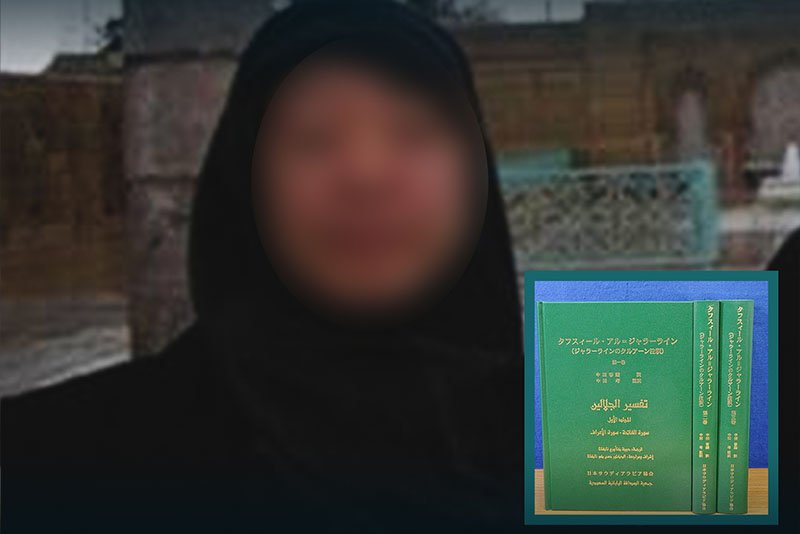
- Tafsir al-Jalalayn: She translated this monumental work of Quranic commentary into Japanese, the first of its kind available in the language.
- Educational Networks: Recognizing the isolation of converts, she established a national educational network for Muslim women. This network transformed a fragmented population into a cohesive community capable of mutual support and shared learning
- Muslim Newspaper: Professor Nakata Ko and she began publishing the monthly Muslim Shinbun in 1992.
- Introductory Works: She authored series on Aqidah (creed), worship and other practices, ensuring new Muslims had a solid foundation.
“The Grace of Illness”: Her Final Days
Even as she faced a terminal illness, Kaori’s dedication to teaching never wavered. She continued to write from her hospice bed until her final breath at the age of 47. Her last work, An Introduction to Allah, served as a commentary on the Risala fi al-Tawhid of Shaykh Arslan al-Dimashqi. It was published in Muslim Shinbun as a series.
Dr. Naoki Yamamoto first became interested in Islam after discovering her ideas in this book.
In the afterword of her final book, written just months before her passing, she shared a profound realization of Tawhid (Oneness) through the lens of her own suffering.
“…Reviewing this book [Risala fi al-Tawhid], I realize that it is a wonderful book. And what is more wonderful is that now we [me and my husband Hasan] are being led to discover it.
The Islamic faith begins with “La ilaha illa Allah” and aims for its perfection, and that is exactly the direction we are now heading.
Until now, we thought we were on our own in worship and everything else. But now I live with the mindset that Allah is doing everything for me. Now I am praying in this wudu because I have a slight paralysis in my lower body and I get gas easily, and I am doing Sajda in gratitude for being given the opportunity to do Sajda here again. I now understand that Qadr and free will are also dualistic issues that do not need to be discussed in the state of Tawhid. I thank Allah for giving me the grace of illness.”
Khawla Nakata Kaori, March 3, 2008
Khawla Nakata Kaori (also known as Habeebah) was a scholar of intellectual grace who proved that Islam is not a “foreign” religion, but a universal truth that can be spoken in any tongue. Her life remains a beacon for Muslims in East Asia and a reminder that the pursuit of knowledge is a journey that ends only when we return to the Creator ﷻ.
Dr. Naoki Yamamoto, Khawla Nakata Kaori, the First Japanese Female Muslim Scholar; Traversing Tradition