‘Sadrush Shariah’ Amjad Ali Azmi: The Hanafi Encyclopedia
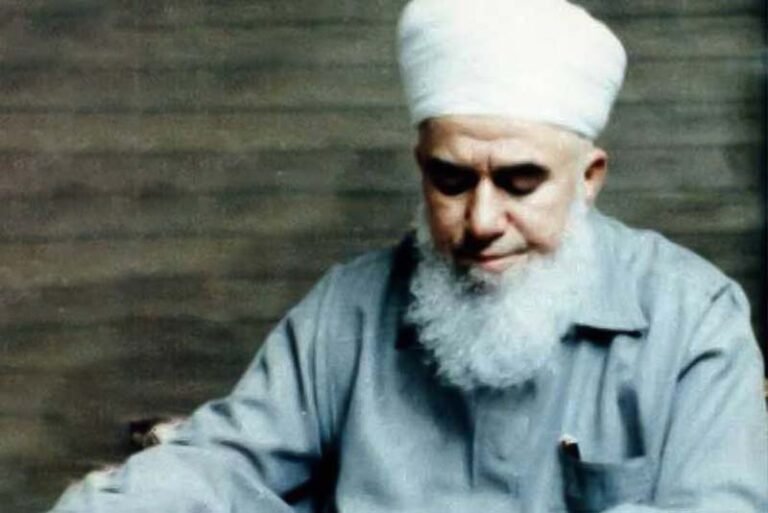
Imām Amjad Ali Azmi (1296–1367 AH / 1878–1948 CE), famously known by the title Şadru’sh Sharīáh, was a titan of Ĥanafī jurisprudence and a key figure in the preservation of Islamic scholarship in the subcontinent.
Early Life and education
- Born in Ghosi, Azamgarh, he came from a family of scholars and physicians; his father, Mawlānā Hakim Jamaluddin, and grandfather, Mawlānā Khudā Bakhsh, were both scholars and experts in Unani medicine.
- He received his early education from his grandfather before studying foundational texts under Mawlānā Muĥammad Şiddīq and Mawlānā Hidāyatullāh Khān Jaunpūrī.
- Later, he traveled to Pīlībhīt to study under the eminent ĥadīth master Mawlānā Waşīy Aĥmed Muĥaddith Sūratī, graduating in 1320 AH (1902 CE).
- Following his family tradition, he also studied Unani medicine under Ĥakīm Ábdu’l Walīy in 1323 AH.
The Relationship with Ala hazrat
His career was transformed when his teacher, Muĥaddith Sūratī, recommended him to Imām Aĥmed Riđā Khān (Ala Hazrat) to teach at the Manżar e Islām school in Bareilly.
While Imām Amjad did not formally study books under Ala Hazrat as a student, he viewed him as his primary spiritual and intellectual mentor. Living in close proximity to Ala Hazrat in Bareilly, he was impressed by his mentor’s strict adherence to the Sharīáh and profound love for the Prophet ﷺ. He became a disciple in the Qādirī path and was eventually appointed as one of Ala Hazrat’s prominent successors (khulafā). Ala Hazrat held him in extremely high esteem, stating that “Mawlawi Amjad Álī is outstanding amongst you in his understanding and perception of religious knowledge (tafaqquh).”
This recognition was due to his sharp nature and mastery of the technique for issuing fatāwā (legal edicts). In Bareilly, he managed a relentless schedule: teaching in the mornings, supervising the press in the afternoons, assisting Ala Hazrat with fatāwā after the Áşr prayer, and working on the press or Qur’an translation until 1 AM or 2 AM. This led contemporaries to remark that he “worked like a machine.”
Academic Life and Teaching Institutions
Mawlānā Amjad Álī’s career as a teacher spanned more than half a century. He was renowned for a rigorous teaching method that required students to read Arabic texts aloud, translate them into proper Urdu, and master grammar and morphology before he provided detailed explanations of the context and legal implications.
He served at the following institutions:
- He began his teaching career in Muĥaddith Sūratī’s School, Pīlībhīt from 1324 to 1327 AH.
- He served in Manżar e Islām, Bareilly on multiple occasions. Initially, he joined on the recommendation of his teacher to assist Ala Hazrat. He returned for a three-year stint in 1351 AH (1932) and again later, teaching there until 1364 AH (1945).
- He served as the head of the Muýīniyyah College, Ajmer: for eight years. During his tenure here, he famously began teaching advanced logic and philosophy to prove his mastery over rational sciences after colleagues claimed he was only proficient in traditional religious sciences.
- He served as the Principal in Hāfiżiyyah Saýīdiyyah College, Dadun for seven years from 1354 to 1362 AH (1935–1943). He also taught in Banaras following his time in Dadun.
Luminaries such as Muĥaddith-e-Aáżam Pakistan Mawlānā Sardār Aĥmad Loyalpūrī and Ĥāfiż-e-Millat Mawlānā Ábdu’l Ázīz Mubarakpūrī, among many others, were his students.
Political and dawah Activity
- Despite being a traditional teacher, he was active and took a prominent role in the committee of scholars, Mútamar al-Úlamā working to address the economic, educational, and religious challenges faced by Muslims during the pre-independence era. It was later evolved as All India Sunni Conference in a huge rally in April 1946. It is said that more than 5,000 scholars and religious leaders had attended that rally.
- During his time in Ajmer, Imām Amjad Álī engaged in significant social and religious reform among the local Rajput communities. Many Rajputs claiming descent from Prithvi Raj had accepted Islam but continued to practice polytheistic rituals due to a lack of awareness of Islamic obligations. He devised a specific program to educate them on the Islamic way of life and encouraged them to forsake idolatrous practices.
- He conducted wider campaigns in various towns around Ajmer such as Naşīrābād, Beawar, Ladnu, Jaipur, Jodhpur, Pali (Marwar), Chittor and others to refute heresies and promote the correct creed of the Ahl al-Sunnah.
The Monumental Kanz al-Īmān
The famous Urdu translation of the Qur’an, Kanz al-Īmān, was largely realized through Imām Amjad’s persistence. Ala Hazrat had postponed the translation due to other scholarly obligations, but Imām Amjad eventually approached him with pen and paper in hand to begin. He witnessed Ala Hazrat dictating the translation extempore without referring to any texts, a feat that left scholars astonished as the spontaneous dictations were in perfect harmony with the most authoritative classical commentaries.
Bahar-e-Shariát: The Magnum Opus
His magnum opus, Bahar-e-Shariát, was written to provide a comprehensive, reliable guide to Ĥanafī jurisprudence in Urdu. It is an encyclopedic work that covers Creed (Áqīdah) and all aspects of law, often synthesizing nearly nine different narrations for a single point of creed to ensure accuracy. Imām Amjad Álī recognized that many existing Urdu books were incomplete or contained errors, so he set out to provide a definitive guide for every aspect of a Muslim’s life.
The work is massive, comprising 17 volumes authored by the Imām himself over a span of 28 years, with the remaining 3 volumes completed by his students based on his notes. Despite its academic rigor, the prose was designed to be clear and direct, serving as a shield for the common believer. Furthermore, he was a master of the rational sciences; when colleagues in Ajmer suggested he was only proficient in traditional sciences, he responded by teaching advanced texts of logic and philosophy to prove his mastery of ma’qūlāt.
Later Life
The later years of his life were marked by staggering personal loss. Between 1358 AH (1939) and 1362 AH (1943), he lost eleven close family members, including several of his sons (Maulvi Muĥammad Yaĥyā, Maulvi Ĥakīm Shamsul Hudā, and Áţā’a al-Muşţafā), daughters, grandchildren, and daughters-in-law. These tragedies, combined with intense labor, took a toll on his health and led to the loss of his eyesight, leaving several projects, including a planned volume on Sufism (Taşawwuf), incomplete.
He bore these trials with legendary patience (şabr), never allowing sorrow to interfere with his duties until his health failed. He passed away on the 2nd of Dhū’l Qaádah 1367 AH (September 1948 CE). His funeral was attended by thousands, and he was laid to rest in his hometown of Ghosi.
A Lasting Legacy
The legacy of Şadru’sh Sharīáh is etched into the fabric of 20th-century Islamic scholarship. He was the “Teacher of Teachers,” producing a legendary cadre of students over 50 years who established hundreds of madrasas across India, Pakistan, and the Western diaspora. He is credited with simplifying complex Ĥanafī legal codes into an accessible Urdu format, providing intellectual and spiritual stabilization for the Sunni community during a period of significant upheaval.
Reference: Abu Hasan, Sadru’sh Shariah: An Introduction to the life and works of Imam Amjad Álī Aáżamī, Ridawi Press, 2026.